The Vatican Museums Tickets Online
The Vatican Museums are among the most visited in the world.
They are visited by over six million visitors annually. This is one of those places that you need to visit at least once in your life.
The Vatican Museums were founded by two popes in the 18th century, Clement XVI and Pius VI, who for the first time opened their collections of works of art to the public for the cultural enlightenment of the people. The first museum complex bears the name of its patrons — the Museo Pio-Clementino.
Today, the Vatican Museums consist of thirty museums and they form an impressive architectural complex that occupies two palaces.
It’s better not to try to see all the museums in one go (it’s a 4.5 km route), but to focus on the specific things you want to see. Otherwise, there is a risk of missing something important. Make sure you also have some free time and energy to visit the Sistine Chapel and the Raphael Rooms (Stanze di Raffaello) located at the end of the route.


The Vatican Museums: Opening Hours
From Monday to Saturday
09.00 a.m. – 06.00 p.m. (final entry 04.00 p.m.)
From 22 April to 29 October 2023
On Fridays and Saturdays extended opening hours until 10.30 p.m. (final entry 08.30 p.m.)
Every last Sunday of the month
(provided this does not coincide with Easter Sunday, 29 June Sts. Peter and Paul, 25 December Christmas Day, and 26 December Feast of St. Stephen)
09.00 a.m. – 02.00 p.m. (final entry 12.30 p.m.)
Free entry
Visitors are required to leave the halls 30 minutes before museum closing time.
Closures 2023
Sunday (except the last Sunday of each month), 1 and 6 January, 11 February, 19 March, 18 April, 29 June, 15,16 August, 1 November, 8 and 25,26 December.
How to Get to the Vatican Museums
The Vatican Museums — Viale Vaticano, 00165 Rome
Metro
- Line A direction Battistini, Ottaviano or Cipro stations
Bus
- 49, stop in the square in front of the Vatican Museums
- 32, 81, 982, stop at Piazza del Risorgimento
- 492, 990, stop in Via Leone IV / Via degli Scipioni
Tram
- 19, stop at Piazza del Risorgimento
The Vatican Museums: to Know Before You Visit
The Vatican Museums were founded by two popes in the 18th century, Clement XVI and Pius VI, who for the first time opened their collections of works of art to the public for the cultural enlightenment of the people. The first museum complex bears the name of its patrons — the Museo Pio-Clementino.
However, the beginning of the museum collection was laid much earlier. Popes from the 15th century collected antique statues, paintings and many other works of world art.
Courtyards of the Vatican Museums Complex
The museum complex consists of two palaces:
- Belvedere, built at the end of the 15th century, in the north
- Apostolic, adjacent to St. Peter’s Basilica (Basilica di Pietro) and being the main papal residence since its transfer from Avignon to the south.
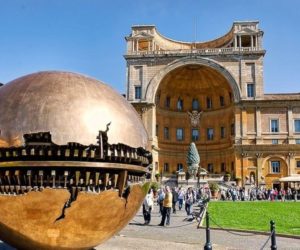
The palaces are connected by two long wings, forming a vast courtyard. The lower courtyard is called the Belvedere Courtyard, while the upper one is known as the Cone Courtyard (Cortile della Pigna).
A cone is a cunning ancient fountain system discovered near the Parthenon at the Baths of Agrippa, which, presumably, belonged to the temple of the goddess Isis. Water flowed down the steps, and two bronze peacocks were placed on the sides. The original of this fountain is now in the new wing. In the middle of the courtyard stands a new bronze statue called «a circle enclosed in a sphere» by Arnaldo Pomodoro in 1990.
Galleries of the Vatican Museums
Two wings connecting the Apostolic Palace and the Belvedere Palace, each about 300 m long. To the east is the Chiaramonti Museum and the Lapidarium. The west wing is occupied by three galleries:
- Gallery of Candelabra about 80 m long, with Greek and Roman sculptures.
- Gallery of Tapestries with tapestries of the 17th century.
- Gallery of Geographical Maps — the longest, 175 m. The walls of this gallery are covered with large drawings of maps created by Antonio Danti. The maps show the cities of Italy, the Mediterranean islands and papal territories. And the frescoes on the ceiling tell about the events that took place in these places.
Halls of the Apostolic Palace
The Renaissance popes invited the best artists to paint their sumptuous residences.
Apartments Borgia
They consist of several chambers that were the private chambers of Alexander VI, Rodrigo De Borgia. The rooms are decorated with frescoes depicting religious and medieval scenes.
Chapel of Nicholas V
Skillfully decorated with frescoes depicting episodes from the life of Saints Stefano and Lorenzo.
Halls of Raphael
Stanze di Raffaello was chosen as a private chamber by Julius II, who did not want to live in the same apartments as his predecessor. From 1508, Raphael worked on the decoration of these rooms, forgetting about other projects, including St. Peter’s Basilica, on which he worked after the death of Bramante. Raphael died in 1520, when he was only 37, without completing the painting of the papal apartments: his students completed the work according to his drawings. These frescoes are considered absolute masterpieces of Renaissance art.
There are four rooms in the Raphael rooms:
- Hall of Constantine (Sala di Costantino) — depicts scenes from the life of the Roman emperor Constantine, who first made Christianity the official religion.
- Eliodoro’s room (Stanza di Eliodoro), with biblical frescoes.
- The Signing Room (Stanza della Segnatura) is named after the highest tribunal of the Holy See and is the only room entirely painted by the artist himself.
- Borgo Fire Room (Stanza dell’Incendio di Borgo) — the most important fresco «Borgo Fire» depicts how Pope Leo IV puts out the fire by making the sign of the cross. This event took place in 847, when a terrible fire destroyed the quarter opposite the ancient St. Peter’s Basilica, which today is called Borgo.


Masterpieces of the Vatican Museums
Chiaramonti Museum
The Chiaramonti Museum has an impressive number of statues, including many busts that the Romans made as portraits of their ancestors. The gallery has a New Corridor (Braccio Nuovo) with a beautiful floor inlaid with Roman mosaics.
Secular Gregorian Museum
The Secular Gregorian Museum (Museo Gregoriano Profano) has a valuable collection of Roman and Greek statues, sculptures, sarcophagi, reliefs and monuments, most of which date back to the period of the Roman Empire.
Etruscan Gregorian Museum
It houses an exceptional collection of vases that reveal the Greek influence in Etruscan decorative art, as well as Greek vases found in Etruscan necropolises, and Italiote vases (made in Hellenic cities in southern Italy) that trace the history of this ancient people.
Gregorian Museum of Egypt
In nine rooms you can admire a collection of stelae and hieroglyphs, Roman copies of Egyptian statues, mummies and sarcophagi. The statues of Egyptian deities are also interesting. Nine halls are located in a semicircle and open onto the terrace of the “Seed of the Cone” (“Nicchione della Pigna”), which houses sculptures. The last two rooms are dedicated to exhibits from Mesopotamia and today’s Palestine.
Vatican Art Gallery
Pinacoteca Vaticana — paintings from the 12th to the 19th century hang in 16 rooms. Most of them are the creations of Italian masters, but some foreign artists are also represented. In particular, an entire room is dedicated to the Austrian artist Peter Menzel. There is also a room dedicated to Raphael. Among the remarkable works of the Grand Master is “The Crowning of the Virgin Mary” (L’Incoronazione della Vergine), which he wrote at the age of 19.
Museum of Contemporary Religious Art
The collection of contemporary religious art is housed in 55 rooms. Here are the works of the most famous artists in the world: Guttuso, Dali, Kandinsky, Kokoschka, Corbusier, Munch, Picasso, Rodin and Van Gogh. The museum is located in the Borgia Apartments (Appartamento Borgia), on the first floor of the Papal Palace, several underground rooms and several on the upper floors of the Sistine Chapel, where the ceremonial masters (Magistri Caeremoniarum) were originally located, responsible for ceremonies and partly for documentation.
Pius Christian Museum
The Museo Pio Cristiano contains a collection of sculptures, sarcophagi and mosaics from the early Christian era. The greatest value of the museum is the statue of the Good Shepherd (Statua del Buon Pastore).
Missionary Ethnological Museum
Museo Missionario Etnologico contains exhibits on religious themes from four parts of the world: Asia, Oceania, Africa and America. Over 100,000 objects were donated to the collection by missionaries. Among the most interesting items are a Mexican statue of the god Quetzalcoatl, a mask from Sierra Leone and a wooden sculpture of the deity Tumataueng from French Polynesia.
Apostolic Library of the Vatican
Today it is one of the most influential and respected libraries in the world, with more than half a million books and 60,000 manuscripts in its vaults. Images of especially valuable specimens can be seen in the Sistine Salon, a magnificent hall 80 m long and 15 m wide, built in 1588 by Domenico Fontana, richly decorated, with painted walls and colored lamps.
The library also houses some of the Vatican Museums, such as Secular and Sacred. The latter contains ancient Christian relics found in the Roman catacombs: bowls and other objects, often made of expensive materials, such as ivory or medieval glaze.
Vatican Historical Museum
They contain a collection of weapons and uniforms of the armed forces of the Pope, as well as portraits of the Popes and the so-called pope-mobiles — the carriages and cars that the Popes rode. There are plans to relocate the museum to the Vatican. Now you can visit it only in advance by ordering a group tour.
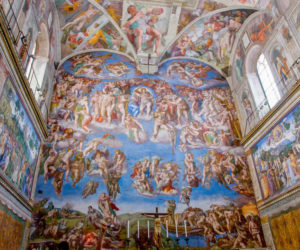
The Sistine Chapel
This is one of the most famous cultural treasures of the Vatican and the world, which is part of the general museum complex. Therefore, you can visit it with a single ticket. It was built in 1475-1481, during the reign of Pope Sixtus IV, from where it got its name.
Without seeing the Sistine Chapel, one cannot understand what a person is capable of. / Johann Wolfgang von Goethe «Travels in Italy».
In 1508 Pope Julius II invited Michelangelo to paint its ceiling. Michelangelo, who considered himself more of an architect and sculptor than an artist, took up the work reluctantly, but decided to depict nine scenes from the Old Testament under the ceiling, the most famous of which is the Creation of Adam (Creazione di Adamo), where God descends from heaven, to breathe life into Adam. The walls of the Chapel are completely covered with frescoes. The most famous is the Last Judgment (Giudizio Universale) on the wall with the altar, also by Michelangelo.